
The Winding Road

0

Writing is not a straight line. At least, not for me.

The Unremarkable Squire was started sometime in 2003, if my memory serves, and revised numerous times before I ever managed to write the last chapter. It’s just now seeing the light of day.

Trouble on the Horizon was published in 2004, and my poor, poor first fans are still waiting for the third novel.

Some projects, like What’s Left of My Life, begin in a spurt of creativity and sputter out because life crowds it out. Or because I get distracted.

I have stories like Twilight Dawn, Cipher, and 100 Letters, which may never get written. And I keep adding new ideas like “Snake Biter Renity Jones” and Children of the Wells. (Wait, what’s that last one, you ask? Stay tuned….)

Plenty of this is my fault. But, you know, it doesn’t bother me much. My brain needs to play. I don’t have a deadline, so I can wander off the path for a bit before coming back, refreshed for whatever project I was supposed to be working on.

And I always have something to work on. I always have something to dream about. I’m always learning. I could not have written Book 3 of The Eternal Night Saga back in 2004 when Trouble of the Horizon was published.

And someday, maybe, I’ll finally be able to express some of the ideas that drove me to writing in the first place.

The Unremarkable Squire Cover

0

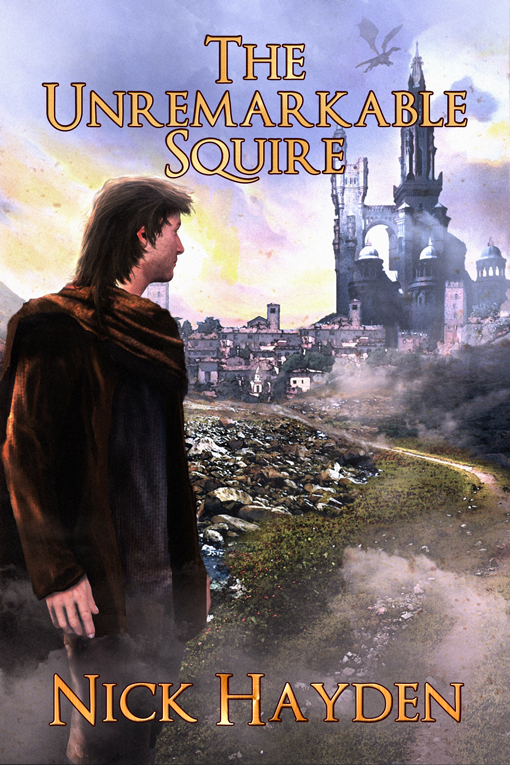
Not an “unremarkable” Squire cover, but a quite awesome cover for my forthcoming fantasy novel  The Unremarkable Squire.

In case you haven’t heard (where have you been?) here’s what it’s about:

A squire’s oath is to be of service… but to whom?

In the kingdom of Basileon, an unremarkable and emotionally detached young man named Obed Kainos is about to stumble into adventure—quite against his will. When the knights of the realm gather in a quest to search for the lost Armor of Arkelon, Obed is chosen at random to replace the recently deceased squire of Sir Lance Valentino. While trying to perform his menial tasks faithfully, the young squire becomes entangled in the plots of mages, thieves, and kings.

And that’s just his first week on the job.

Unfortunately for Obed, his indifference cannot save him from his new oath. For despite his enigmatic personality (or perhaps because of it), he manages to attract a band of misfits to his cause— the ugly, the arrogant, the clumsy, and the cowardly—putting the legendary armor within the grasp of one who never wanted anything at all.

Sign up for a free preview of the first four chapters when they’re available: http://www.barkingrainpress.org/squire-preview/

Scheduled release date is December 2012.

Full Moon

2

“Look, daddy, look!”

My going-on-three-year-old son points out the window of the van as I drive home.

“Wow, the moon is big tonight, isn’t it?”

“Daddy, I want to get it.”

“Well, how are you going to get it?”

He thinks seriously for a moment, drawing out his “Um…” before saying decisively, “Catch it in net.”

“Good idea.” We are just about home. “We’ll get your net when we go inside, okay?”

“Okay.”

I park, unlatch him from his seat, and carry him inside. “Go get your net.”

“Oh, yeah.” He races off to his room. I follow to turn on his light. He already has his toy drawer open and is rummaging through it. “How ‘bout green one, daddy?”

“The green net will be great.” He has several nets, which he uses for a type of basketball game instead of catching bugs.

“Up, daddy!”

I pick him up and we head outside. I hold him in my arms and he stretches, trying to reach the moon. “I can’t get it.”

“Here, get on my shoulders.”

He tries again. He groans with the effort. “Daddy do it.”

“No, you can do it. Let’s try this.” I grab him again, lifting him over my head. “Try again.” He swings his net unsuccessfully. “Almost. Try a few more times.” I stand on my tiptoes. “Careful, I’m going to try and jump. Get ready. One, two, three, jump!”

“I got it, daddy, I got it!”

I lower him. He shows me the moon, taking it out of the net and handing it to me. “Wow,” I say. “It’s so bright. What are you going to do with it?”

“Put it in my room.”

“Where in your room?”

“On the floor so everyone can see it.”

“Okay, let’s go.”

We go inside. He sets it carefully on the floor.

“Can I hold it?”

“No, daddy. It’s mine.”

I tell him it’s time for bed; it’s late enough he’s ready for it. He holds the moon in his hands as I change him. Getting his arms through the sleeves of his pajamas is complicated, but we manage.

“Time for night-night,” I tell him.

“Sleep with moon?”

“As long as you go to sleep.”

“Sleep for little bit?”

“For a long time. All night. But you can hold the moon if you want.”

I pray with him and sing to him. He smiles at me sweetly, sleepily. “It’s pretty.”

“It’s very pretty.”

“I will keep the moon.”

“You can keep it tonight, but tomorrow we have to put it back in the sky.”

“I will keep it.”

“Other kids want to see the moon, too. If you keep it here, no one else will be able to see it. You have to share.”

He looks at me seriously. “I want to share with daddy.”

I can’t help but smile. “That’s very nice. But we need to share with everyone, okay. Tomorrow, we put it back.”

“Okay, daddy.”

One more song, and I close the door.

Every morning, my son gets up, leaves his room, and stands expectantly at the side of my bed. I sense him and turn to him, and he says, “Daddy, get up!” and I eventually do. This morning, however, when I turn to him, he says, “Daddy, I’m sharing the moon. I’m sharing it!”

I’m groggy and don’t understand.

“Get up, daddy, get up! I’ll show you!”

I get up and he leads me to the back door, which isn’t quite latched. He shouldn’t be able to open it on his own. He is clever, though. He opens the door for me, rushing out first. “Look!”

He points. The moon is there, high up, pale in the dim morning sky. “I threw it up there, all by me-self.”

“That was very nice of you,” I say. It’s beautiful there in the sky. I hope other kids point it out to their fathers. “But you can’t leave the house without mommy or daddy, okay?”

“Okay, daddy.” He’s grinning. “Wanna catch it.”

“Again?”

“Yeah. Catch it again.”

“No, not again. Let someone else catch it, okay?”

“Okay, daddy.”
Heart-Think

0

Come Together

Hartwig HKD via Compfight

One of the powers of the storyteller is that he makes you feel.

Say, for instance, there’s this guy. We’ll call him Tristan. And he’s madly in love with this princess, but she’s married. We’ll call her, I don’t know, Isolde.

For a time, they sneak around in passionate, forbidden love. It’s exciting and dangerous. They shouldn’t be doing it, but…. They can’t even finish the thought before covering each other in kisses.

The king finds out, puts a stop to it. Bad things happen all around. Feelings are hurt. People die. Maybe a war breaks out.

Isolde will never be happy again. Her true love is gone. The only light in her life has been snuffed out.

If some nun gives a closing speech about how these were the consequences to Tristan and Isolde’s sin, would we buy into it?

Or would the passion and heartache linger on as the intellectual argument faded away?

RL

0

The Wonderful Wizard of Oz

Rita M. via Compfight

Real life, in case you’ve forgotten, is that thing that happens outside of the stories that surround us.

Real life moves slower than stories. It makes less sense. It’s not as black-and-white. Usually, it’s far less entertaining.

In real life, you don’t know what chapter you’re in. Maybe you’re somewhere in the middle. Maybe you have 10 pages left.

Real life requires something of you. Actually, it requires everything, if you’re going to do it right.

Real life is first person, so the interpretation of events is likely to be skewed.

Revision is a bit trickier in real life.

But I believe there is an Author. It’s usually best if I work with him. He does, after all, know the whole story.


Desire

0

At its most basic, desire simply means the protagonist wants something. If he can’t get what he wants, conflict ensues. A story is born.

For me, however, the relationship between storytelling and desire have another, more personal meaning.

That longing for something you can’t quite express, the hope for something that doesn’t quite exist in this world–that desire is at the heart of why I tell stories. It shows up in The Eternal Night Saga, in the forthcoming The Unremarkable Squire, and in many of my short stories.

I first really captured this in “The Memory,” my first truly “good” short story. If I may quote the opening:

It was a memory more precious than any other she had. It was worn and faded, frayed at the edges, but even extensive viewing had not distorted it. It had never had the feel of a memory, but of something else more elusive, something akin to a snatch of a dream or a scene from a book read in childhood.


Her memory was of lights and warmth and insubstantial shapes. It had no particulars, nothing real, only shadows of some reality, and brilliant lights, glowing like the sky on these cold, lonely nights. And warmth like a blanket, a fire, sleep on a dark morning when nothing is awake except the frigid wind.


The owner of this memory was sometimes less sure of her own name than of the reality of the memory. This frightened her. For if the memory was false, could she depend on her own existence? But she did not think on such things. She contemplated the memory, examining it endlessly, hoping to extract some clue or revelation from it. There was nothing. She gained nothing from it except a desire to continue forward.

“The Memory” is the opening story of Dreams & Visions, an ebook short story collection. All the works in Dreams & Visions deal with the idea of desire in some way. It’s a theme I keep coming back to.

If you’re interested, the ebook is available on Smashwords for free for a limited time (till July 31, 2012; use the code SSWIN). It’s also available on Amazon and most other major ebook retailers for a measly $.99.

If you read them and enjoy them, let me know. I love the stories. Maybe you will too.

Sitting With A Book

1

On the platform, reading

Mo Riza via Compfight

Occasionally, I look at the list of books I’d like to read and wish I could read faster.

That’s not the problem, though. Reading isn’t a race; it isn’t an attempt to cram more knowledge in your head, not with fiction. It’s a chance reconnect and recover.

Reading should take time. A year reading, say, Les Miserables, is a year well-spent. (Or longer, if you’re me.) The brain and soul need to soak in words and worlds. It is possibly more important than ever to find a place and time to stop “productive” work and read.

Today, I feel extremely busy. A whirlwind of activity does not lend itself to thoughtful consideration or soul-searching. Reading a good book almost always does.

Hero Material

2

just take my hand let's fly away

Funkyah via Compfight

If a protagonist wakes up fully rested, eats breakfast, enjoys his day at work, comes home to his lovely wife and kids, fiddles on some project, and goes to bed, we might think one of two things:

1.) This is a terrible story.

2.) Uh-oh, everything’s going to hit the fan soon.

We expect conflict in the story. If our hero doesn’t get thwarted or beat up or dumped or magically teleported to a far-off land, we’re disappointed. We reach for a different story.

But if life thwarts us or gives us a black eye or dumps us or magically teleports us to a far-off land (or just another state), we’re liable to throw up our hands and ask God what we did wrong.

Interestingly, the Bible tends to find value in suffering. And perhaps there’s something to that. Heroes aren’t often made in a story without conflict, and maybe, just maybe, God thinks we’re hero material.

You Know That Feeling

0

I know you do. You feel it when the credits roll and you’re glad you paid $9+ because it sparked something you haven’t quite identified yet.  You feel it when you look at some landscape; it’s not just beautiful, it’s saying something. Sometimes it’s a snatch of music, a few notes, maybe just a sound, that resonates in your soul.  Maybe it’s a nighttime musing–something clicks, and the world makes a little more sense than it did before.

And you have an idea.

Not just an idea, but an idea that needs to be shared. A revelation. An epiphany.

And you hold it in your hands, examining it, feeling its warmth, mesmerized by its glow. You want to soak it in, and you want, somehow, to make others feel and think the exact same way you’re feeling and thinking this very moment.

It’s nice, feeling creative.

Doing something about it. Well, that’s another matter entirely.

Away

1

I’m in North Carolina right now. Since we have two young kids, we split the trip in half. Last night we camped.

(Note to self: Camping with young kids on the longest day of the year may not have been the brightest idea.)

My son Fyo was so excited about camping, but when it was time to finally go to bed, the long trip, early morning, and functionally non-existent nap caught up.

“I want to go home,” he cried.

It’s very hard to say, “We can’t go home,” to a sad, tired two-year-old.

So often, it seems the “I want to go home” character motivation is simply an excuse for another, more exciting plot. The audience doesn’t want the hero to go home; there’s no adventure at home. If the crew of the Battlestar Galactica or Voyager finds Earth, the show’s over.

But we all know that deep desire to go home. My son knows it, and he made me feel it. To really communicate that in a story would be to tap into something primal and powerful.