Interview with Michael Goodyear

1

This entry is part 4 of 4 in the series Interviews with Nick

Published April 3, 2010

After a long absence from the joys and rigors of a reporter’s life, I have found myself thrust back into my role as intermediary between personalities of note and the general public. Soon after my first re-publishing of my previous interviews, I received a called from Mr. Michael Goodyear, who requested an interview. Seeming a gentlemen of interest, and indeed wishing to return to that most noble of professions—journalism—I could not refuse. Michael Goodyear is the founder and president of Twice the Christian, a organization of no little note. Below, I record our conversation.

Nick: Good afternoon, Mr. Goodyear.

Michael: Please, call me Mike. It sounds like you’re talking to my father.

Nick: (laughing) Very well, Mike. You said on the phone you’re the founder of a group called Twice the Christian. What’s the group’s purpose? I want to say it’s dedicated to some sort of secret formula to living the Christian life, but my wife thinks otherwise. Who’s right?

Michael: The woman’s always right, you know that. No, Twice the Christian’s purpose is to help a marginalized and often overlooked segment of the Christian church feel welcomed and accepted.

Nick: Which group is this? The X-Games crowd?

Michael: Nope. Try again.

Nick: Gays?

Michael: Popular guess, but wrong.

Nick: Politicians?

Michael: You’ll never guess it. It’s not even on your radar. The Biannuals.

Nick: Er…who?

Michael: Biannuals is a technical term for those people who only attend church on Christmas and Easter. They’ve been grossly neglected by the Christian church and even abused.

Nick: …Abused?

Michael: Yes, that’s exactly the word. Abused by guilt. They look in their closet and think, Well, I better dress up so that no one thinks I’m a slob. They shuffle into the sanctuary, almost petrified by the fear of taking someone else’s pew. They pull a ten out of their wallet when the offering basket comes around, having no choice in the matter. They can feel the pressure of twenty centuries of tradition squeezing them into a little teeny, itty-bitty box. And what do they get for their heroic efforts? The same two sermons over and over again.

Nick: I can see what you mean…but, they could come other weeks…there’re a lot of churches that would be more than welcoming….

Michael: You’re missing the point, Nick. It’s not about welcoming. It’s about burdens. The truth will set you free and all that. We Biannuals, we don’t want to come more often. And, quite frankly, we don’t think we need to. That’s what’s so wonderful about Christianity.

Nick: I get that. I really do. But, then, how can you say you’re being abused and—

Michael: It’s in their eyes. It’s in the way they handle their Bibles, like they know where everything is. They think they’re so much better than us, just because they sing songs with the name Jesus in it.

Nick: I think that’s a rather unfair thing to say.

Michael: Look, times change. Life is so much busier now than it was 100 years ago. Who wants to get up on Sunday morning and listen to some words from an old book? There’re new books to read, and new movies to watch, sports teams to follow, Farmtown crops to harvest. We have to streamline. We have to be more efficient. The Biannuals understand this. Two Sundays instead of fifty-two. Birth and Death. We get everything, we just get it more effectively. Like Cliff Notes.

Nick: Okay, okay…just, okay. For the sake of argument, let’s say Christianity is only about showing up for an hour on Sunday morning. You’re saying that a fan of Jesus only has to come two hours a year.

Michael: Yes.

Nick: Would you also say you could be considered a fan of say, LOST, if you only watched the finales?

Michael: That’s what I’m trying to tell you. By condensing visits to church, we make time to watch awesome shows like LOST. And V. And that cooking show with the crazy Japanese guy who introduces the secret ingredients.

Nick: If I told you Christianity was about a relationship, and that relationships take time to mature, what would you say?

Michael: I’d say you were closed-minded, tight-fisted, tea-bagging bigot.

Nick: Ah…

Michael: But I wouldn’t hold it against you.

Nick: That’s nice of you.

Michael: Someday you’ll understand that everything is instantaneous, that everything is easy, that everything is free, that everything should be ours at the touch of a button, and that this is the future. We won’t stand for anything else. I can read the writing on the wall. The Church needs to, also.

Nick: (under his breath) Now that I’m thoroughly depressed…. (Louder) Well, yes, thank you for your insights, Mike. It was interesting to hear your point of view.

Michael: Thanks. I’m glad. Strange phrase, don’t you think—the writing on the wall. Where do you suppose it’s from?

Nick: (shrugging) Who knows? I suppose you could look it up on Wikipedia.
Interview with Roman God Janus

0

This entry is part 3 of 4 in the series Interviews with Nick

Originally published January 5, 2008

Nick: For the first interview of 2008, I had to pull a few strings, make a few calls, but our guest today was kind enough to make the long trek to Kendallville for an exclusive. In the hot seat today is none other than Janus, patron god of January. Welcome.

(Janus inclines his head.)

Nick: It must be quite an honor to have a month named after you, especially such an important one. How does it make you feel to claim the first month of every new year as your own?

Janus: I look forward to it with eager anticipation. When it comes, I am always disappointed.

Nick: I’m sorry to hear that.

Janus: The future is always better than the present. You can dream about the future; you can change the future. But when the future arrives as the present, it smacks you in the face, bloodies your nose, and bustles past without so much as a “Pardon me.”

Nick: I suppose that happens sometimes…

Janus: It gets worse, though. By the time you brush yourself off and steel yourself for another day, dreaming about how this time she’ll smile at you and shake your hand and maybe give you a pat on the back, tomorrow comes and hits you over the head with a sledgehammer. After that, all you can think of is how wonderful yesterday was when all you got was a bloody nose. And soon you begin to look upon the bloody nose with a sort of fondness and you begin to say to yourself, “Remember how warm that blood was and how alive I felt when I hit the ground and how much I appreciated the experience. I always have a story to share at parties now.” And so you begin to dream about bloody noses. But tomorrow comes and steps on your toes instead. Then the next day spits in your face. A whole week stares at you as if ready to perform an act of wickedness but does nothing but grin slyly and walk away. Suddenly, one day arrives and greets you fondly, hugs you and even kisses you, but you’re so preoccupied with the dream of a bloody nose that you don’t even notice. By the time you get it into your head what’s happened, another week has passed in sullen silence. You discard your dreams of bloody noses, looking again for that Sweet Day that kissed you and–whack!–there’s the bully smashing in your face again.

Nick: Er…that a rather cynical view of life…

Janus: Do you know what I remember of my 16th birthday?

Nick: I’m afraid I don’t.

Janus: We had ice cream cake. All my friends were over and quite a few people I didn’t like, too. I opened loads of gifts, and my Dad even bought home a used chariot he had purchased for me. It should have been a wonderful birthday. But Proserpina was there, and she handed me my present so sweetly, smiling at me like she saw only me. But she held Pluto’s hand. I have her gift still at home. It’s such a shameful gift. Every time I look at it I remember that day and how I wanted nothing more than for her to kiss me, for her to spit in Pluto’s face. And I’m ashamed of the gift now because I’m aware that she’ll never kiss me, but I still keep it and dream and make little fantasies in my head about how she’ll kiss me someday.

Nick: (silence) …I’m sorry.

Janus: Don’t be. You might as well apologize for the creation of the world. I know better than most how constantly disappointed we all are. But if Jupiter, the father of gods, changes lovers with the setting and rising of the sun, I don’t see how the rest of us are going to manage much better. As mutable as the father, so all those under him.

Nick: …I don’t believe Jupiter is the father of gods.

Janus: Oh, you’re one of those Cronus worshippers. He’s in prison, you know.

Nick: No…older than that, who’s not so…changeable. I’ll explain after the interview. One final question: You’re well-known among the gods for having two faces, one that looks forward and one that looks backward. Do you think having these two faces hinders you from living in the present?

Janus: Look, the present holds only a single moment. I have centuries of regrets, guilt, bitterness, fond memories, and nostalgia burdening me down and centuries of daydreams, hopes, plans, anxieties, and fantasies lifting me up. What does the measly present have on that?

Nick: Well, some have said that the present is where we touch eternity.

Janus: I know for a fact that I have eternity too. Late at night, sometimes, I relive all my best moments and lament at their passing. Or I stew in regret and construct fantasies to relieve me of them. I’ve lived quite a few eternities on my bed. Do you think living life comparable to that? What worlds I have in my head!

Nick: I can imagine. Well, thank you Janus for your time today. If you don’t mind staying a moment, I can explain what I meant earlier.

Interview with Ms. Regina Svetlana

1

This entry is part 2 of 4 in the series Interviews with Nick

Originally published on December 22, 2007

My dear readers, I am truly humbled by the response my first interview has made among certain circles. Within a day of its publication, I received no less than four phone calls from parties interested in my services. Even with the approach of Christmas and the New Year, these people were willing to set aside a few moments of their precious time to speak with me. It is too great an honor for this lowly reporter. And, indeed, it is too much work, since I shall soon be leaving town for Christmas and afterward play my part as groomsman at a good friend’s wedding. I had time for one short interview only, which I chose due to its critical importance to the season.

Nick: Good evening, Ms. Svetlana. Let me thank you again for taking time out of your busy schedule.

Ms. Svetlana: Not a problem, not a problem. I’m always open to spreading the word on this crucial subject. It is a pressing, modern problem and it must be dealt with immediately.

Nick: Good. First, tell us what this problem is.

Ms. Svetlana: Well, it’s obvious, isn’t it? Santa Claus is the problem.

Nick: You mean that many people teach their children about Santa and you believe we shouldn’t?

Ms. Svetlana: What? Look, every kid grows up knowing Santa and to think otherwise is plain idiocy. He’s a powerful cultural figure, as real to us today as Zeus and Athena were to the ancient Greeks. That’s why I fear him. He has the power to sway millions of children each year, and he uses it to destroy them.

Nick: …and how is this?

Ms. Svetlana: Cookies, Mr. Hayden. He conquers his subjects with cookies.

Nick: …um…and how is this?

Ms. Svetlana: Look, it’s quite obvious. This superman, Santa Claus, demands an offering of cookies from every boy and girl on the planet. Now, I don’t know what he does with them all, he may throw most of them away for all I know. But we know for a fact that he eats a good many of them. Other sources attest quite regularly to his stomach which resembles a “bowl full of jelly.” A more disgusting image I cannot find in all the literature of this man. What is worst, this grotesque man, fat and bloated from his yearly bacchanalian binge, is looked upon as jolly and even venerable. What does this teach our children, let me ask you that? I’ll tell you what it teaches them! It teaches them that to be happy and holy, one must eat cookies! A few years ago we made a small victory with that blue cooking-eating maniac on Sesame Street, but that was only a skirmish. Santa Claus—now he’s the real foe!

Nick: Ms. Svetlana, if you could please sit…

Ms. Svetlana: Sit? Sit! As if I could stay seated while millions of children are brainwashed by this trickster demigod! Have you no feeling?

Nick: (stammering) I do agree that obesity is a real problem in some cases—

Ms. Svetlana: Exactly, exactly! Which is why this year we’re pushing our newest products. Ready—this is genius—“Saint Nick’s Celery Sticks”!

Nick: Saint Nick’s Celery Sticks?

Ms. Svetlana: Yes, yes! Say it with me again. Together—Saint Nick’s…

Nick: …Celery Sticks.

Ms. Svetlana: Our five-year goal is to totally replace Santa’s cookies with these festively packaged celery sticks. Since celery has a negative caloric intake, Santa will actually lose weight every year, so with say, ten years, he will be a slim, trim elderly man, with an increase in energy and a decrease in heart disease. This change will affect children at an emotional level, and they too will take to eating celery instead of cookies. Brilliant, isn’t it?

Nick: Well, yes…it’s all sounds good…and I see you have an honorable goal and all…

Ms. Svetlana: What is it?

Nick: I can’t help but wonder if holidays shouldn’t be celebrated with cookies.

Ms. Svetlana: Of course you’d say that. How old are you anyway, eighteen?

Nick: Twenty-seven.

Ms. Svetlana: In any case, you’ve got the metabolism of a Tasmanian Devil, haven’t you? You don’t have to worry about cookies going straight to your hips, do you?

Nick: Er…

Ms. Svetlana: What is it with you people, huh? Can’t you see we’re just bags of consumption? Can’t you see that we’re giant waste converters? Food’s a necessary evil, like oil and natural gas! We consume and consume and tear Nature apart and drive the Earth to wrath! Oh, do you know why I hate Santa? The sheer extravagance of the man! Eight reindeer when he could use two, ten presents when he could give one. And the plate of cookies! And he actually enjoys them! This interview is over, Mr. Hayden. Have a Merry Christmas!

(Ms. Svetlana stomps out.)

Nick: (sighing) I’ll have to tell Natasha I didn’t have time to give the Chex Mix we made her.

Interview with Donald Merriman

1

This entry is part 1 of 4 in the series Interviews with Nick

Originally published December 20, 2007

In college, I, Nick Hayden, would occasionally interview the movers and shakers of the world and post the transcripts via email to those who were interested in such personages. At the time, my main subject was Stuart Lem, headmaster of the prestigious Lem Institute. Recently, I have observed the events and circumstances of these modern days and yearned more and more to dig deeper into the psyche of those who make the news. Then, as luck would have it—or Providence, if one believes in such a thing—I stumbled into Don Merriman, a fascinating gentleman. Having heard some of his story, and of his particular passions, I could no longer restrain myself. I arranged an interview. If God is willing, this will be the first of many to open the nation’s eyes to those who are doing the most good in these present times and who strive to usher us into a new age of prosperity and peace.

Nick: Hello, Donald. Let me thank you again for the pleasure of this interview.

Don: The pleasure is mine, Nick.

Nick: We’ve talked some, and I know you wear many hats. You’re a business owner, a family man, a member of your church council, but you have a special passion this time of year. Tell me about that.

Don: Well, I like to call myself a Christmas Crusader.

Nick: And what does that mean?

Don: I fight for Christmas. Particularly, I’m the guy that makes sure that every megastore and billion-dollar corporation uses the words “Merry Christmas” and not “Happy Holidays.”

Nick: I know that this is a major issue for many people. For those who don’t know, explain it in a nutshell.

Don: It’s a war, Nick. It’s as simple as that. It’s a war for the soul of this nation. “Happy Holidays” is the devil’s language for self-worship, idolatry, and rebellion.

Nick: That’s pretty strong language.

Don: The Bible is full of strong language, Nick.

Nick: That’s true, but…I’m not sure I follow. How does the Bible apply to saying “Merry Christmas”?

Don: You know what Mark 8:38 says, don’t you?

Nick: Um…not off-hand.

Don: “If anyone is ashamed of me and my words in this adulterous and sinful generation, the Son of Man will be ashamed of him when he comes in his Father’s glory with the holy angels.”

Nick: So, refusal to say “Merry Christmas” is a sign of rejecting Jesus Christ?

Don: Absolutely. Without a doubt.

Nick: What about Spanish speakers? They say “Feliz Navidad.”

Don: If they’re legal, they speak English. If they’re illegal…don’t get me started.

Nick: And if they’re Mexican citizens?

Don: (getting irritated) We’re talking about America, aren’t we? Why are we bringing Mexico into it?

Nick: Yes, of course. I’m sorry. Where were we?

Don: Forcing every business and household in American to proclaim “Merry Christmas” with joy, love, and intense fervor.

Nick: Ah, yes. How do you go about doing that?

Don: First, we send an official complaint. Then, when they answer us with a nasty letter, we start a petition.

Nick: How many people usually sign a petition?

Don: Roughly five billion.

Nick: Er…ah…you mean, five million, I suppose?

Don: Nope. Five billion.

Nick: I…sorry if I sound incredulous, but that’s like 80% of the population of the earth.

Don: (laughing) That is ridiculous. No, we keep sending the petition around until we get a few billion signatures. I signed the last petition about ten thousand times. That really shows them.

Nick: …Ah…alright. Do the petitions get the job done?

Don: Many times, yes. When they don’t we have a third option. Massive boycott. But it’s not just your regular boycott. Say you have two competing corporations. One bows down before our boycott, the other doesn’t. We then tell everyone to boycott the latter and shop religiously at the first. This not only punishes the perpetrator’s profit margin, where it really hurts, but their fiercest competitor keeps raking in the dough. How’s that for pressure?

Nick: So…you reward companies that say “Merry Christmas” by buying their product?

Don: Yes.

Nick: Let me phrase this another way: You purposely connect the expression “Merry Christmas” to massive consumption?

Don: Yes. What’s the problem?

Nick: Never mind. One last question. I know some Christian who, though they firmly believe that Jesus is the reason for the season, so to speak, don’t agree with your strong arm tactics. How would you respond to them?

Don: I’d say, Look, Christians are told to suit up in armor, right? Fight the good fight. Defend God’s honor and bring his kingdom to earth now, as soon as possible. For goodness sake, Paul even talks about wielding the Sword of Truth! That’s what I’m doing—showing the big man what’s true!

Nick: I believe it’s the sword of the Spirit.

Don: Whatever.

Nick: Well, thank you for your time, Don. I think my readers can at least agree with you on the meaning of Christmas. I hope you and your family have a very Merry Christmas.

Don: Thank you, Nick. Same to you.

Nick: Oh, quick question. What’s your take on Easter?

Don: Easter? What do you mean?

Nick: I mean, should we call it “Resurrectionmas” or something?

Don: (laughing) Whatever for? Really, you have strange ideas! Easter’s not a corporate holy-day.

Dinner at Twilight

1

It is twilight. Shadows lie curled like dogs in front of the fire. The table is set for dinner. The Lady Delia sits upon one end, her husband, Lord Cronin upon the other.

“You have done well tonight,” says the Lord, wiping his mouth with the back of his hand. He is a large, ugly man.

“I have had nothing but time,” replies his wife. She is sprightly, with a child’s face. But she does not smile.

“Winters last long upon the mountain. You will grow used to them.”

“Yes, my Lord.”

* * *

It is twilight again. Shadows lie like snow in the deep crevices. The table is set for dinner.

“You look sad, wife.”

But the Lady Delia does not answer as she stirs the wilted beans about her plate.

“I know you must miss your family. When spring comes, you can visit them. You see how lonely I was before we wed. It was only I in this castle, alone. But now you are here. Let us enjoy the long winter together.”

The Lady nods demurely. “Of course.”

The Lord sips his wine. “Do you hate me?”

There is no answer.

* * *

It is twilight again. Shadows lie heavy in the halls, like a pregnant woman upon her bed. The table is set for dinner.

The Lord is distracted. He has brought papers from his study, and he is scrawling out astronomical calculations.

“Why have you no servants?” the Lady asks.

The Lord reaches a satisfying answer. “Yes, I’m right. That must be the explanation for the star’s retrograde motion….”

“Husband,” the Lady says, her voice golden, “why have you no servants?”

“You know why. The curse. This is an empty castle.”

“But if there were a child?”

He looks up at her. “It would die.”

“But you—”

“My mother died instead. That is the choice. I will not allow it to happen to you.”

* * *

It is twilight again. Shadows lie cold and shivering in the corners, huddled for warmth. The table is dispensed with. The Lord and Lady sit near the blazing fire.

“More?” The Lady pours wine into her husband’s empty cup.

“Thank you.” His speech is slurred. “I—I don’t know how I lived here, alone. Before I married, it was just me. And the bats. So much work and sweat. You’re beautiful, you know. I was afraid you’d hate me. There’s so much misery in my family tree… But—you’re smiling. It’s not winter when you smile. Even in this blasted storm, I don’t feel so cold.”

“That’s the wine.”

“Is it?” He studies his half-empty cup. “Maybe it is. More then.”

The Lady hesitates. “Surely, you’ve had enough.”

“More—to keep us warm?”

She makes a decision. “Of course, husband.” And she fills his cup.

* * *

It is twilight again. Shadows lie sad and barren like corpses in their graves. The table is set for dinner, but the Lord’s food is untouched.

He is coughing as he tries to swallow a sliver of mountain goat. He reaches, trembling, for his wine, to wash it down. His wife does not look at him, but concentrates on her food.

With a final hack, the Lord gains control of himself. “You are very pale.”

“As are you,” answers the Lady.

“Are you afraid?”

“Of what, husband?”

“This sickness. It’s nothing unusual, I assure you. It’s the cold that causes it. I won’t leave you alone.”

“I know,” the Lady says. “You love me too much.”

“I do,” he says. The coughing starts up again.

* * *

It is twilight. Shadows loom over the rooms like the hand of Death. The table has not been set in days. The Lord lays in his bed.

The Lady holds his cold hand. She is crying.

“I….” She finds it difficult to speak. She could not tell him when he was alive; she must tell him in death. “I had to. Bit by bit. In the wine you loved. I hated you when I first married you, but now I.… But I had to. The curse—the curse, that only two can live in the castle, that only two can survive in the family line….”

She touches her belly. She is just beginning to show.

The candle goes out. It is night.

This story has been sponsored by Summer Moser.

Two o’clock

0

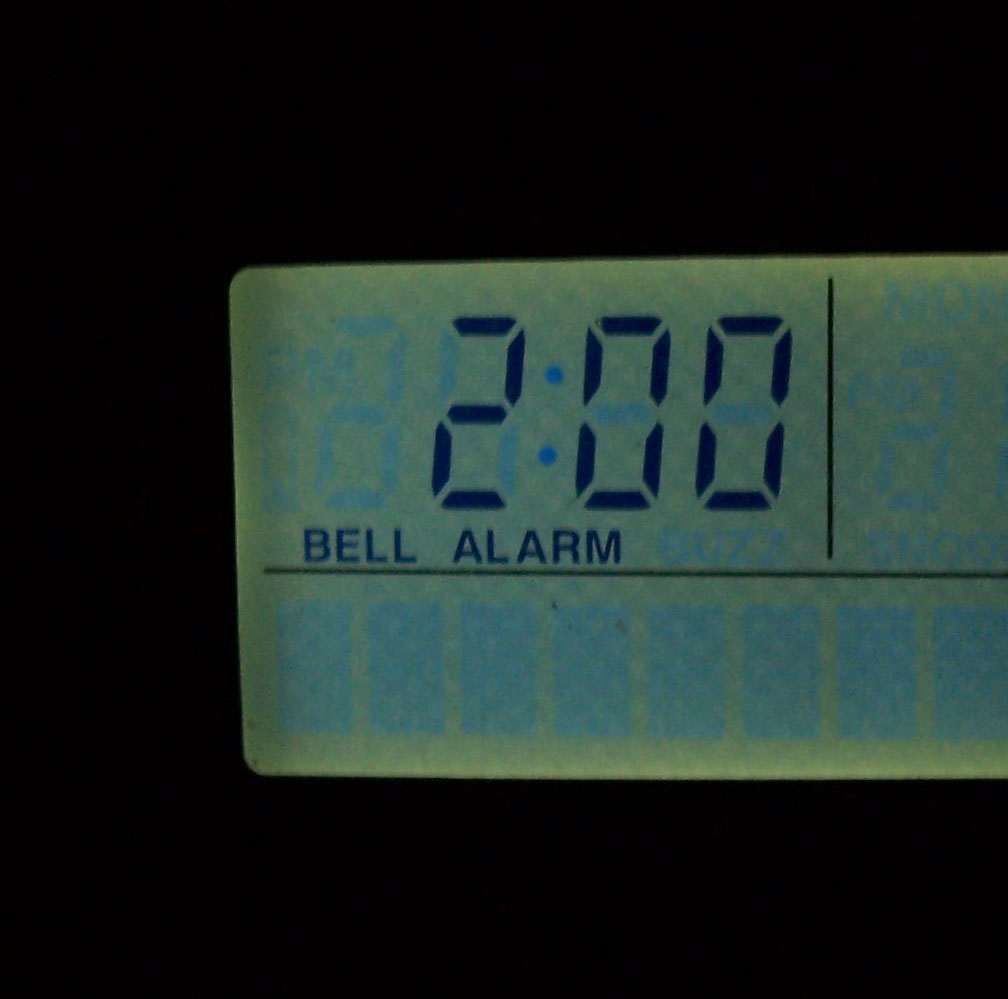
Two o’clock at night is a pillow pressed against my face, smothering me, hot and dark and full of terror. The world is asleep in its grave at two o’clock, and I’m still awake, unable to sleep, aware of every sound, aware of every second as it flashes out of existence like a burnt-out bulb. Two o’clock is 3600 endless moments of darkness, 3600 ghosts passing through my body, 3600 miseries contemplated and added one to another on the compost heap of my brain. Two o’clock is 3600 ticks of the clock. Tick, tick, tick, tick, tick….

Three o’clock.

The knowledge of what will save me occurs as I stare at the microwave. 3:01. There is no hope in returning to bed. I’d lie there, wide-awake, a thousand unanswerable questions passing before me every minute, whole recitations of my own personal book of Job—but no storm, no revelation of God, only my husband’s gentle breathing as he sleeps. He’ll wake to a new world. How sick and aged and feeble is mine!

It is four o’clock before I gather the will to stand, nearly five before I’ve decorated my shell in a vain attempt at normalcy. I don’t know why it takes so long. I don’t remember any of it, only the conviction that my actions are futile, that the coming morning means nothing but a setting sun, that there is no end and no hope and no God.

The sun begins its slow spread of color as I pull out of the garage. From black to gray, like a photograph being developed. That much I observe. I drive without conscious thought, braking, turning, taking curves, obeying the rules of the road. The car directs my path; I sit at the wheel, granting it permission by my touch.

Sunrise. Like blood. I shudder. I don’t know why I make the association. I imagine dead bodies, bloodied corpses. Bird flu, swine flu, a biological attack, an apocalypse. Cities dead. Children dead.

I pull over, unable to drive. No God, but still I pray. I have to pray.

Eventually, I begin again. Eventually, I arrive in town. The streets are becoming busy, and I’m anxious, tired, frustrated, claustrophobic. I pull off the main road, park, stare, trying to escape.

I see so often with my mind’s eye, it’s a revelation to see truly. Something about the building catches my attention, something about the lines, about the landscape. It’s orderly, solid, peaceful. I’m afraid to look away. Whatever I see in it might disappear if I look away.

I make up my mind. I made it up sometime between two and three o’clock, but it only now reaches the surface. It only now has control over my will.

I keep everything in the trunk, in the back seat, a few brushes in the glove compartment. I gather everything quickly, frantically, all my lethargy gone in an instant.

No easel. Too bulky. Doesn’t matter. I make do. A bench I drag to the right spot. A trash can. Quickly, colors on the palette, brushes laid out. First, I sketch. The pencil isn’t sharp, but it works. Minimal outline. I’m too impatient. The sun is up. I want to make color dance on the white. I want to capture what I see, what I saw, even if no one else sees it. I need to see it.

Finally, the brush and the color. Bold, solid, earthy colors.

I believe in God when I paint. I feel the thickness of the paint, the friction beneath my brush, the order emerging from nothing, from chaos, feel the light as if it were an emotion, a touch, a kiss. I am in communion with the one who created it, and I can believe.

Again, time passes without my knowledge. I am the vision before me, the copy of creation beneath my hands. I am the colors mixing, spreading, forming, combining. This is two o’clock beneath the sun, two o’clock bathed in beauty, two o’clock in heaven.

I feel him at my shoulder. He’s not the first to peer at my work in interest, but I sense the difference.

“I’m sorry,” I say.

“You should have woken me.” My husband isn’t reproving me; he just wants to help. That is why I can’t answer him. He doesn’t understand. He can’t, because the sun always shines in his world. I need that from him.

“Will you be finished soon?” he asks. Someone must have seen me and told him where I was. Unless he drove around, searching. He’s done that, too.

“Soon.”

“It’s really good.”

I know he means it. Our walls are full of desperate art.

“I’ll stay with you till you finish, if you don’t mind.” He touches me gently on the shoulder. A touch like light.

“Thank you.”

I paint more slowly now, trying to stretch out the moments, trying to soak in the color and the light and his presence. I’m changed. And when I’m changed, I begin to believe that two o’clock beneath the sun can last forever.

The Coming Darkness

0

The city below lay shrouded in darkness, with only a few pinpricks of light shining from the street lamps and windows.

“I don’t remember ever seeing it that dim,” Eljar muttered.

“There’s several good veins past the Black Valley,” his uncle reminded him, “and there’s potential beyond the Empty Sea. And that doesn’t count where we’re going.”

“I know. Eljar turned away from the city and continued up the winding path alongside his uncle. “But what happens when there’s no more? It’ll run out eventually. Then there’ll be no more light.”

His uncle shook his bearded head. “That’s not out concern. Our job is to mine the light and bring it back.”

They traveled with a group of near fifty miners with six light orbs between them. They ascended the City Stairs, a path well-known to them all. It curved along the Cavern of the City and opened into the Wide Expanse, a room with a ceiling hundreds of feet high. While a distance from the city, events were sometimes held here rather than along the Shoreline closer to the city proper.

Eljar joined the singing after the mining party turned into Elmo’s Detour. It helped pass the time and helped lift his gloomy spirits.

He was not the only one concerned about the eventual end of light. Many of the younger generation could see the signs. The long-used mines were running dim, and the new ones took greater and greater effort to harvest because of distance and location. Eljar wanted to prepare his people for the coming darkness, wanted to help reorganize society upon proper lines, but those in power hemmed and hawed and did nothing.

Eljan usually fell into the routine of travel after the first night, listening to the oft-repated stories and innocently crude jokes of the men, and when they arrived at the work site, he worked deligently, swinging his pick with the pleasure of exertion. Food never tasted as good as after those long days of work. Sleep was as inviting as a kiss. He did not think of tomorrow or the next day, he did not worry of the future of his race and the necessity of saving everything by his efforts. He worked and sweated and laughed and slept. He remembered his worries only once he returned to the city and to his circle of friends.

But this time was different. Day by day the darkness grew more oppressive. The dozen orbs that illuminated the path seemed, in his mind, to flicker, like a prophecy of the end of the days of light. The coarse joking and worn-out stories were thin and tattered; he could sense naked desperation beneath them. Every step was a waste, a fool’s expedition, a blind man’s journey. The light would eventually go out. Eljan was convinced of it now more than ever. If only he could make them see!

The expected days of travel passed, then two more as they wend their way through uncleared territory. They squeezed through slivers of passage, sidling sideways, scraping by, abandoning their wagons until they could widen the way later.

When they finally emerged from these tangles, natural, un-harvested light blinded them—but it was a trick of the eyes. Even a handful of pristine light could blind one used to the dark.

They began their work.

Eljar grew angry. Each swing of his pick felt a mockery and a betrayal. His friends back home were laughing at him, doubting his convictions. His uncle didn’t understand. None of these men did. Buthe understood. He wiped the sweat from his face, repressing a cry of rage. He wanted to throw down his tools and stomp away and savor his co-workers’ reactions.

Three days passed. Wretched, monotonous, futile days. Vast amounts of light were being harvested. He chose a narrow dead-end away from the others where he could escape their songs. He cursed when his arms shuddered beneath a blow. He flung the freed jewels of light into a pile, wanting nothing more than to be done with it all.

With a final blow, he dislodged another, tossed it aside, and decided to rest. A cavity gaped in the opening his work had created. Something about it caught his eye. He could sense light. He peered in. The cavity became a tunnel, just large enough for someone to fit into. He squeezed in, his curiosity growing, and followed it up as it ascended, the brightness increasing until he had to shield his eyes. Soon, he could not even continue forward the light was so bright. He did not know if a lode so bright had been found in a century, perhaps not since the loss of the Sky and the Sun. How far up did this tunnel go?

He made up his mind. Maneuvering down and out, he gripped his pick in his hand and smashed the surrounding rock, his muscles burning, his breath ragged. It was what need to be done.

They must prepare for the coming darkness. The light would only prolong hope.

For the first time since the expedition began, Eljar smiled.

The Fiery Demise of Chuck Norris

1

Freddie knew it was going to be a bad day when he checked his RSS feeds and discovered Chuck Norris had exploded during the night. There were no details, just the bald fact of his demise.

This shattered Freddie’s entire existence. He climbed under his bed, clutched the crocheted Dalek doll his aunt had made him, and sobbed until his parents tried to convince him to come out.

“He’s gone!” he screamed in response to their consoling words. “Chuck Norris is gone!”

“At least he went in a fiery explosion,” his dad tried.

Freddie emitted a high-pitched squeal that marked all his worst moods.

“Now, honey, I know you really loved Chuck Norris—”

“You don’t know. You don’t understand, you can’t understand!”

And, perhaps, they didn’t.

Ever since his discovery of Chuck Norris, his mind had been fixated on the unexplained phenomena of the universe, as if Chuck Norris embodied all that was exotic and wonderful and impossibly possible. Freddie had always been a rather strange, frightfully odd little boy, obsessed with fractals and derivatives and atomic processes when other boys were playing with robots and cars, so when he began to talk to them about Chuck Norris, about his hero’s indestructibility, about Chuck Norris’ frightful presence and sheer omnipotence, the other kids listened, adding their own comments, which he disregarded as uninformed and childish.

In any event, he refused to come out from underneath the bed, and eventually his parents gave up their attempts. All day Freddie refused their offers of food, though he did drink three juice boxes and once ran to the bathroom when no one was looking.

Even his younger sister, who usually ignored Freddie, trundled in and sat, peering beneath the bed at him. “Wassa matta?” she asked. “Wassa matta?”

“He was such a star,” Freddie lamented, starring up at the bedframe. “There never was a star like him, Maddie, never. He was such a big star. No one was powerful enough to destroy Chuck Norris. Nothing could hurt Chuck Norris. But…but…” His lips quivered. “It was his own fault!” he wailed. “It was all his fault! And now he’s gone!”

Freddie’s sudden outburst made Maddie cry, and their shrieks filled the house until their parents could soothe them.

That night they held a memorial for Chuck Norris in the backyard. Freddie’s father had dug a large hole, and Freddie laid his memorabilia in it—his sketches and short stories and colorings of Chuck Norris. But he could not part with the plaque.

“I have to keep a little bit of him,” Freddie explained solemnly. Then, taking the too-big shovel, he tried to cover up the hole, but only succeeded in getting a splinter in his hand and breaking down completely. He fell asleep moaning and groaning.

At about three in the morning, though, he rushed into his parents’ room. “Mom! Dad! I’m all better! I’m not sad anymore!”

His mom, whose night it was to deal with Freddie’s late night incidents, asked groggily, “Why not?”

“Because Chuck Norris didn’t explode last night. I just figured it out. He exploded 171,231 years ago! Isn’t that great?”

His mother did not ask what this meant but said she was very glad to hear it and tucked him back into bed.

He fell asleep almost as soon as she settled the sheets over him. He had curled up with the Certificate from the International Star Registry they had gotten him for his last birthday.

Back in bed, his mother jabbed his father in the ribs to wake him. “This is your fault, you know.”

“What is?”

“This. I wanted to get him nice glow-in-the-dark stars to put on his walls.”

“How was I supposed to know it would go supernova? And, come on, admit it, Chuck Norris is an awesome name for a star.”

“He almost had an emotional meltdown.”

His father yawned. “He always does that. Be thankful we didn’t buy him a goldfish.”

Memory Lane

0

What surprised him most was how vividly he remembered it all the moment he stepped inside—the linoleum tiles, the blue lockers, the stained ceiling tiles, the tired yellow fluorescent bulbs. He had hated those bulbs. They made the hallways feel more claustrophobic than they already were. Add to that the teeming mass of brutish teens…. Even the change to white lights might have made high school less of a prison. A little less.

The hallways were empty now, the classroom doors shut. He was alone in the junior hall, alone with his memories.

He caught a whiff of BO and chalk and perfume and old books. He felt suddenly awkward, filled with regret, nostalgia, longing, shame…. He almost exited right then.

He could not sort out his emotions. Pain threaded the disparate feelings into a single ache, but he could not tell if it might not be good pain, pleasant pain. He had been such a raw, untested personality in those days. He had suffered more in the imaginings of an hour those four years than in a week of his present workaday world. Wasn’t that living, to dream and dare and die, even if only in his head?

“Ethan, is that you?”

He looked up out of his thoughts and saw her, somehow unchanged from those days. So slender, with her long hair in a loose tail, the same jeans, the same checkered shirt. He had never seen her with a cowboy hat, but it had always seemed the natural progression. Half cowgirl, half…what? Shy, innocent, but not meek—assertive, but not controlling. Vibrant. That was it.

“Uh…hi.”

“What are you doing here?”

He almost answered truthfully, but that would destroy everything, destroy the moment. “I was just…skipping class.” He forced a smirk, joking as best he could.

She smiled knowingly, as if she knew his secret. She glanced over her shoulder. “I thought you would come. Do you know, there’s something I always wanted to say.” She blushed and left it unsaid.

“What? What is it?” A feeling of giddy dread washed over him.

“Never mind,” she said quickly, shaking her head. But she beamed.

“I always liked you, too,” Ethan blurted out. “I was too scared to say anything. Do you know how many times I planned what I would say to you, imagined how you would respond, physically caught up in the idea of you say…saying that you….?” He could not get the words out. She was glowing, positively glowing. “But I didn’t. I never told you. I let it pass me by. It was just a fancy, something I imagined, I was too scared to see what would happen if I actually lived it. I thought maybe I invented those hints I saw, that maybe I created a version of you in my head, like Pygmalion. Do you remember how we worked together on that English project? I suffered s—”

The colors faded from her face. She looked sick. The entire world turned gray, even the horrid yellow lights. She became motionless, like an image from a photograph.

Between Ethan and her appeared a message, written in bold letters:

THE DEMO VERSION OF VIRTUAL MEMORY HAS EXPIRED
PURCHASE THE FULL VERSION FOR $199.95
RELIVE & REINVENT YOUR FAVORITE MEMORIES TODAY!

The Best Thing in the Whole World

0

Alex lay on the floor, crying inconsolably.

“Do you want to play get-you? Why don’t we play get-you?”

A new, hysterical pitch entered Alex’s fit. The boy was overtired. But Grandma was not without resources.

“Maybe we can go outside and jump in the puddles. Doesn’t that sound fun?”

Alex shook his head, his face still pressed against the kitchen floor.

“I think we have one of your Mighty Machines here. The one with the big crane.”

Even this failed to draw Alex from his hysteria.

Not only was Alex tired—he hadn’t slept much the night before, according to his mother—but mother had forgotten to pack his favorite blankie. That was the real problem.

Grandma didn’t like to hear him crying, but she knew it was best to wait him out. She heard her dryer beep, and she got an idea.

“Alex, I’m going to go find the best thing in the whole wide world. Do you want to help me?”

“No,” he managed in a broken voice.

“That’s all right. I wish you would come with me, though. I want to share the best thing in the whole world with you. Are you sure you don’t want to come?”

He didn’t respond, but his cries were quieting.

“I’ll be in the bathroom if you want to find the best thing in the world, okay?”

He entered a few minutes later, wiping tears from his cheeks. Grandma kept folding clothes. “Hello, Alex. Are you ready to find the best thing in the whole world, now?”

He nodded sadly.

“Come here. I think it’s in here.” She stopped the dryer and opened it, lifting him up so he could see inside. “Do you see it?”

“No,” he said quietly.

“It’s in there. I’ll help you.” She reached in and pulled out a towel. “Feel it.”

“It’s hot.”

She set him on the floor and wrapped the warm towel around him. “Isn’t that wonderful?”

A twinkle entered his eyes. “Grandma,” he said after a moment of thought, “this is the best thing in the whole world!”

“Lay down. I’ll get you another one when that one gets cold.”

After the second towel, he fell asleep, and Grandma watched his peaceful face, confident that she had indeed discovered the best thing in the world.